
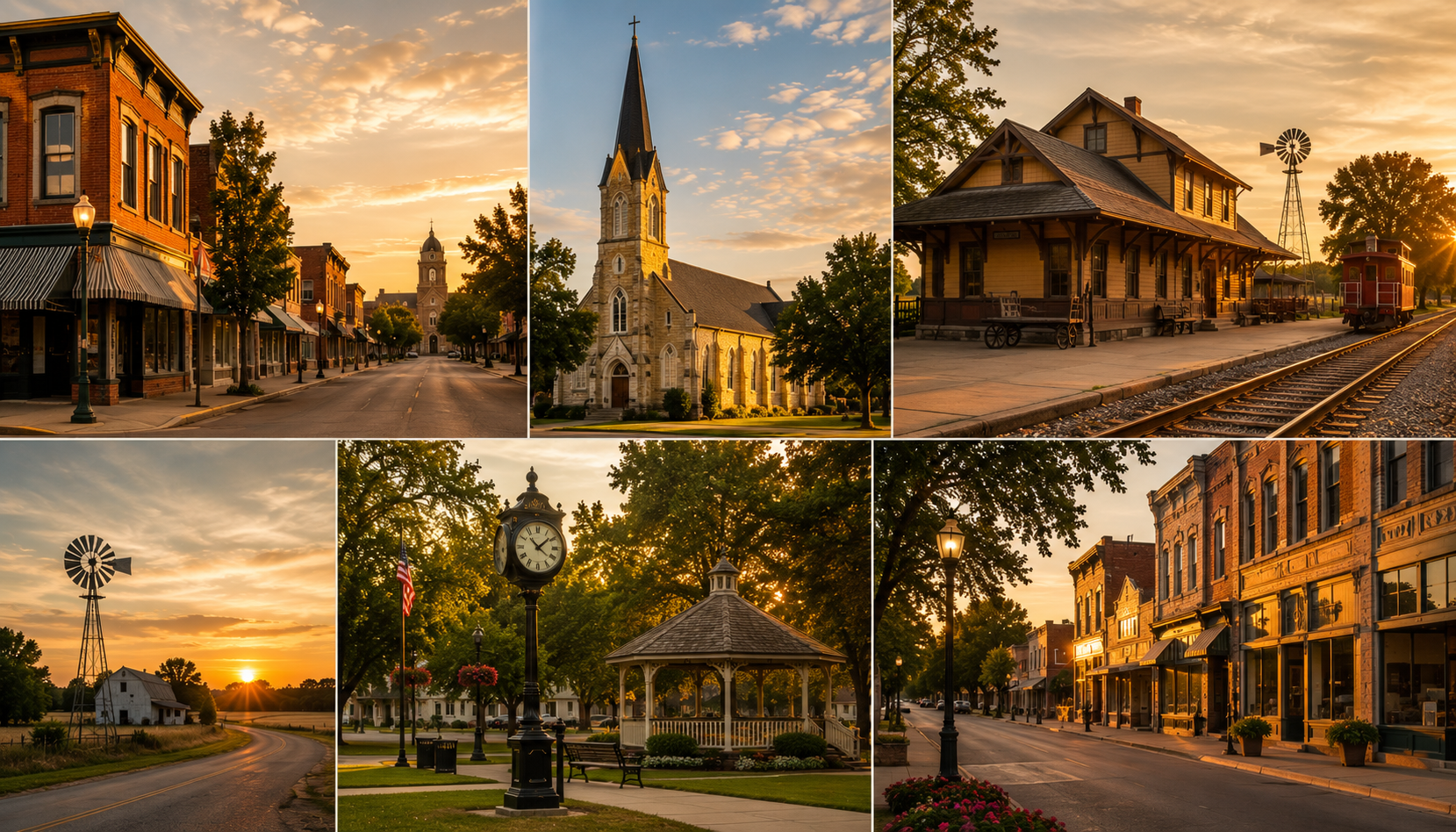
Kansas gets underestimated as a travel destination. But pull off the highway, drive the county roads, and you’ll find history sitting right out in the open — unpolished, unhurried, and genuinely worth stopping for.
That’s the Kansas most people drive through without stopping. The historic sites near Wichita and throughout the surrounding region are exactly this kind — unpretentious, specific, and surprisingly moving if you slow down enough to actually look at them.
If you’re based near Wichita for any length of time, the day trips available to you in any direction are more rewarding than most first-time visitors expect. This guide is the one to read before you leave the park in the morning.
Why Kansas Punches Above Its Weight for Heritage Travel
A quick word on context. Kansas heritage travel benefits from something that many more celebrated heritage destinations have lost: the buildings are still there, and they’re still doing what they were built to do. The courthouse in Newton is still the courthouse. The stone post office in Council Grove still sorts mail. The old churches in small Harvey County communities still hold Sunday services for the same families whose grandparents built them.
That continuity is harder to find than most people realize. In states with more aggressive development pressure, historic buildings get converted, repurposed, or demolished. In Kansas, a lot of them just quietly continue. The state has over 3,000 sites listed on the National Register of Historic Places — a number that surprises people who picture Kansas as flat, featureless, and historically thin.
It’s not. And the area around Wichita is a good place to start proving that.
“Kansas history didn’t happen quietly. It happened loudly — cattle drives, railroad wars, frontier violence, Prohibition battles, civil rights struggles — and it left buildings behind.”
Wichita Itself: Local Architecture Worth a Walking Tour
Before venturing out to the smaller towns, it’s worth spending time with the local architecture of Wichita itself. The city has more historic built fabric than its reputation suggests, and several neighborhoods and districts reward slow exploration.
Old Town Wichita
The Old Town district is the most concentrated example of Wichita’s late 19th and early 20th century commercial architecture. The brick warehouses and commercial buildings that line Douglas Avenue and the surrounding blocks were built during the city’s cattle trade and early railroad boom — a period of genuine prosperity that funded ambitious construction. The scale is different from what was built in the same era in smaller Kansas towns: bigger lots, taller buildings, more ornamental detail on the facades. Walking the Old Town district on a weekday morning, before the evening entertainment crowd arrives, gives you a much better sense of the architecture than a Saturday night visit does.
The Wichita-Sedgwick County Historical Museum
Housed in the 1892 Romanesque Revival City Hall building — a genuinely impressive piece of civic architecture in its own right — the historical museum gives you the documentary side of what you’ll see in the field. Understanding the cattle trade era, the oil boom, the aircraft industry that reshaped Wichita in the 20th century, and the various communities that built the city makes the buildings you’ll see on day trips significantly more meaningful. It’s worth a few hours before the road trips begin.
College Hill and the Riverside Neighborhood
For residential historic architecture, Wichita’s College Hill and Riverside neighborhoods have concentrations of early 20th century homes — Craftsman bungalows, Prairie style houses, Colonial Revival — that reflect the city’s middle-class prosperity in the interwar period. Not every visitor is interested in residential architecture, but for anyone who loves the domestic side of American building history, these neighborhoods are genuinely lovely for a slow drive or walk.
To get a solid picture of what Wichita has to offer beyond just the historic buildings, the Wichita exploration guide at Wichita RV Park is worth reading before you plan your days — it covers more of what makes the city worth spending time in.
Halstead: A Small-Town Gem Worth the Drive
Halstead is about 25 miles northwest of Wichita on the Little Arkansas River, and it’s one of those places that rewards visitors who don’t expect it to be anything other than what it is — a small Kansas town with a genuine history and enough intact architecture to make a morning walk interesting.
The downtown commercial district has late 19th and early 20th century storefronts that are unusually well-preserved. Several buildings retain original brick facades, cast iron details, and the general proportion of a prosperous small-town main street from the era when this stretch of central Kansas was growing fast on the back of wheat agriculture. The Halstead Heritage Museum provides good local context for what you’re seeing on the street.
Halstead also has one of the more interesting small-town stories in Harvey County — it was an early center of Mennonite settlement in Kansas, and that community’s influence on the town’s architecture, agriculture, and general character is still visible. The guide to exploring Halstead at Wichita RV Park gives a more detailed picture of what makes this community worth the short drive from Wichita.
Hidden Historic Towns Kansas: Beyond the Main Roads
The real rewards of hidden historic towns in Kansas come when you’re willing to get off US-54 and K-96 and drive the county roads. Here are a few towns that consistently surprise people who find them.
Newton — The Original End of the Chisholm Trail
Newton, about 20 miles north of Wichita, was the first major cattle-shipping terminus on the Chisholm Trail — before Abilene, before Dodge City — and its history reflects that violent, prosperous, chaotic moment in Kansas history. The Harvey County courthouse is an excellent piece of Richardson Romanesque architecture. The downtown commercial district has intact buildings from the rail town era. Newton’s Mennonite heritage adds another layer to the story — the Bethel College campus just outside town is worth a visit for its architecture and its museum of Mennonite history.
Eldorado — The Butler County Seat
El Dorado (pronounced locally with a flat Midwestern El-duh-RAY-do) is the Butler County seat about 25 miles east of Wichita, and its courthouse square is one of the better-preserved examples of the Kansas county seat architectural tradition. The Butler County Courthouse — built in 1910 in a Classical Revival style — anchors a downtown that still has active businesses in buildings from the early 20th century. El Dorado has its own oil history from the early 20th century boom, and the El Dorado State Park nearby adds a natural recreation dimension to the day trip.
Peabody — The Stone Buildings Tell the Story
Peabody, in Marion County about 40 miles north of Wichita, is one of the more architecturally interesting small towns in central Kansas. The town has a concentration of limestone commercial buildings from the 1870s and 1880s that are unusually intact and reflect the native stone building tradition that shaped small towns across the Flint Hills region. The Peabody historic district is on the National Register and has been the subject of preservation efforts that have kept the downtown in better shape than many comparable Kansas towns.
Roadside Landmarks: The Wichita Region’s Distinctive Stops
Roadside landmarks near Wichita are the kind of thing you stumble onto when you’re driving county roads with a general direction in mind and no fixed schedule. Kansas has more of these than it gets credit for.
The Keeper of the Plains sculpture at the confluence of the Arkansas and Little Arkansas rivers in Wichita is probably the most photographed landmark in the city — a 44-foot steel sculpture on a pedestrian island, with fire rings that light up at designated times in the evening. It’s a dramatic piece of public art in a setting that reflects Wichita’s Native American heritage, particularly the Wichita tribe for whom the city is named.
Old Cowtown Museum, also in Wichita, reconstructs a frontier cattle town with original and period-appropriate buildings — a living history museum format that works well for visitors who want the cattle trade era presented in three dimensions rather than just through artifacts and photographs.
For travelers who want to explore east of Wichita, the area near Andover has its own local history and character worth investigating. The RV park near Andover is a convenient base if your exploration is pulling you in that direction.
Planning Your Heritage Day Trips from Wichita
The geography here works in your favor. Wichita sits at roughly the center of south-central Kansas, which means day trips in any direction cover different terrain and different historical stories. Go north for the Chisholm Trail cattle country and Flint Hills edges. Go east for the Osage prairie and the oil patch history of Butler County. Go northwest for Harvey County’s Mennonite heritage and the Little Arkansas River towns.
Two or three days of dedicated heritage exploration from a Wichita base covers an enormous amount of genuinely interesting ground. The roads are good, distances are manageable, and the towns you find are almost universally welcoming to visitors who show up with genuine curiosity rather than tourist-circuit expectations.
For RV travelers looking to base themselves comfortably for this kind of exploration, Wichita RV Park puts you centrally positioned for day trips in any direction. Whether you’re planning a short-term stay with a focused itinerary or a longer-term stay that lets you take the exploration slowly over several weeks, the park’s location and amenities support either approach well.
For more ideas and current information on what’s worth exploring in and around the Wichita area, the Wichita RV Park blog is a practical resource updated with local knowledge that fixed guides can’t always provide.
What Makes Kansas Historic Sites Different
Here’s what’s worth understanding before you go: Kansas historic sites aren’t packaged. There’s no interpretive center at the edge of the Peabody historic district telling you what to think about the limestone storefronts. The Newton courthouse doesn’t have an audio tour. The old grain elevators standing at the edge of small towns along the Arkansas River don’t have plaques.
You bring the curiousity, and the places reward it. That’s a different experience from the major heritage destinations that have been developed for visitors — and for some travelers, a much more satisfying one. You’re not consuming history. You’re discovering it, slowly, on your own terms, from the window of a truck or on foot down a main street that’s been there since before your grandparents were born.
Kansas does this quietly. Which is exactly why it works as well as it does for the traveler who knows how to look.
Frequently Asked Questions
What are the most historically significant sites near Wichita, KS?
The Wichita-Sedgwick County Historical Museum, Old Cowtown Museum, and the Keeper of the Plains are the best-known in the city itself. Within a 30-mile radius, Newton’s Harvey County Courthouse and its Chisholm Trail heritage, El Dorado’s courthouse square, and the Peabody historic district in Marion County are among the most rewarding destinations for heritage-focused visitors. Halstead’s Mennonite heritage and downtown architecture round out a solid regional picture.
Are the historic sites near Wichita RV-friendly?
Most are. The small-town historic districts in Newton, El Dorado, Peabody, and Halstead all have main street or adjacent parking that accommodates larger vehicles without significant difficulty. Wichita’s Old Town district has more urban parking constraints but is manageable with a tow vehicle. The Keeper of the Plains and Cowtown Museum both have parking facilities that handle various vehicle sizes. Mid-week visits generally offer more flexibility than weekend visits when street parking near historic areas fills up faster.
What is the Chisholm Trail and why does it matter to Wichita’s history?
The Chisholm Trail was a major cattle driving route used from roughly 1867 to the mid-1880s to move Texas longhorn cattle north to Kansas railroad shipping points. Wichita served as a major terminus on the trail in the early 1870s, and the cattle trade defined the city’s early character — bringing both prosperity and the frontier violence that accompanied the cattle town era. Newton, just north of Wichita, was the first major end-of-trail shipping point before Wichita took over that role. The era’s legacy is visible in local museums, architectural remnants, and the broader cultural identity of south-central Kansas.
What is the best day trip from Wichita for someone interested in small-town Kansas history?
Newton makes the strongest single day-trip case — it’s 20 miles north, has good architecture in the downtown commercial district and the Harvey County Courthouse, offers the Bethel College campus and Mennonite heritage museum, and has enough local restaurants and coffee shops to make a full day comfortable. For a longer day that covers more ground, combining Newton with Peabody (an additional 20 miles northwest) gives you two distinct architectural and community characters in a single outing.
How many days do I need to properly explore the historic sites around Wichita?
Two to three dedicated heritage days covers the major highlights well — a day in Wichita itself, a day focused on the northwest corridor (Newton, Halstead, Peabody), and a day east toward El Dorado and Butler County. A longer stay of a week or more opens up additional destinations further afield, including the Flint Hills tallgrass prairie country to the north and the Medicine Lodge area to the southwest, both of which add significant historical depth to the central Kansas picture.
What architectural styles are most common in historic Kansas buildings?
Central Kansas historic architecture is dominated by two material traditions: brick construction in the more prosperous eastern and river-corridor communities, and native limestone in the Flint Hills and surrounding regions where the stone was locally abundant. Architectural styles in historic downtowns typically range from Italianate commercial storefronts from the 1870s through 1880s to Classical Revival civic and commercial buildings from the early 1900s. Romanesque Revival appears in several of the region’s most impressive courthouse buildings. The domestic residential tradition in cities like Wichita follows national patterns — Craftsman, Colonial Revival, and Prairie influence are all visible in the early 20th century neighborhoods.