Kansas in July doesn’t apologize for itself. The sun sits high and flat over the prairie, the humidity adds a damp weight to the air, and the temperature climbs into the mid-to-upper 90s by early afternoon without any particular sympathy for your outdoor plans. But Spring Lake RV Resort in Halstead has a specific answer to all of this — and it involves a lot of water and more shade than you might expect from central Kansas.
The Lake Is the Point
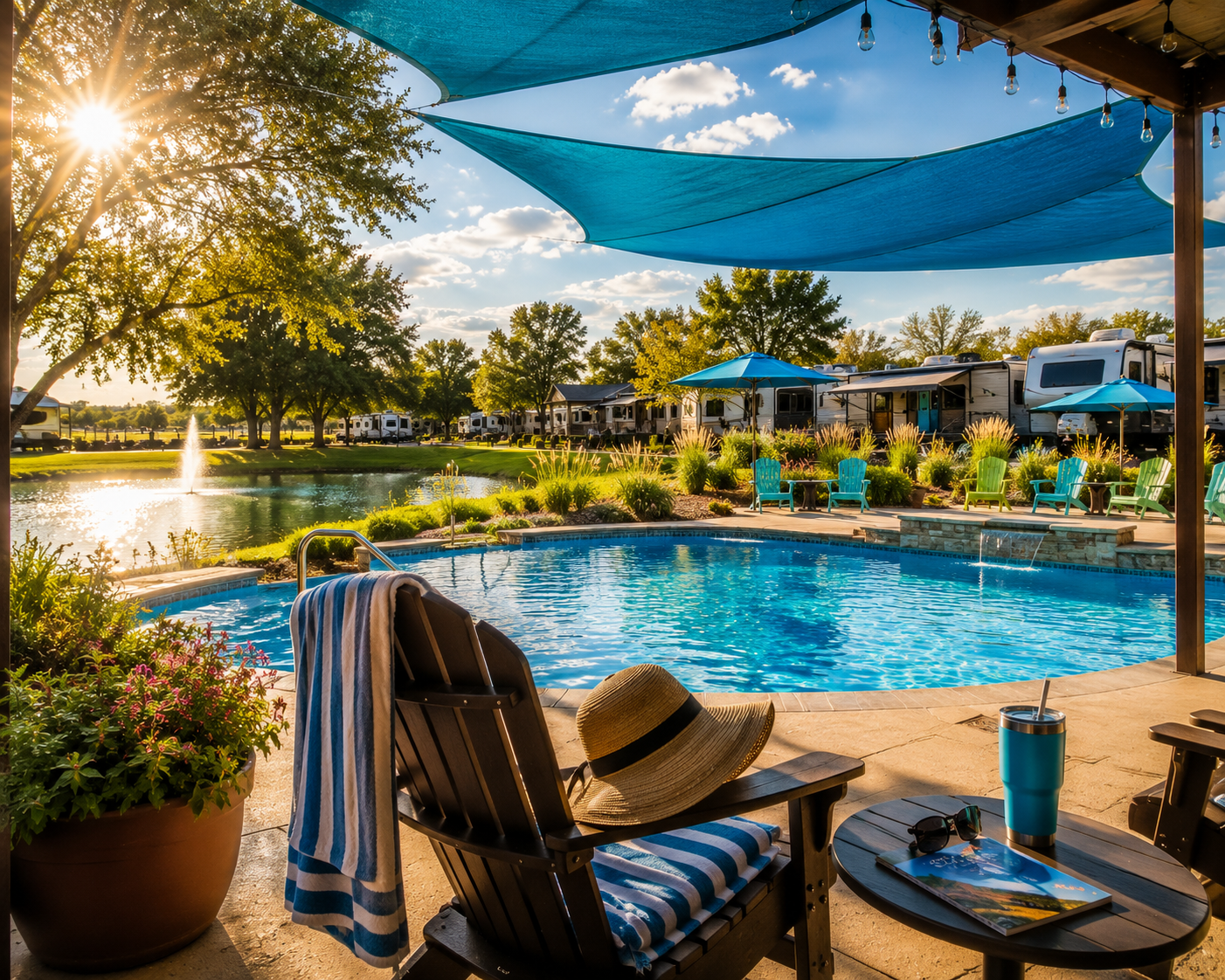
Spring Lake RV Resort is built around an actual lake, and in July in Kansas, that’s not an incidental feature — it’s the entire point. The lake is the best heat management tool on the property by a wide margin, and using it well is the foundation of a comfortable summer stay.
The water temperature at Spring Lake in July is warmer than a mountain stream or a spring-fed Hill Country river, but it’s significantly cooler than the ambient air — typically 75-82°F in midsummer, which feels genuinely refreshing when you’re coming off a 98°F afternoon. The principle here isn’t the same as swimming in a cold mountain lake; it’s the evaporative cooling effect that even moderately cool water produces as you get out. That temperature differential between your wet skin and the surrounding air creates a brief but significant cooling window that resets your body temperature in a way that shade and breeze alone can’t match.
Fishing from the bank in the early morning and evening is a different experience in July — the lake environment runs noticeably cooler than the open campsite terrain, and the shade of the lake’s tree line in the morning is worth getting up for specifically.
“The lake isn’t just a nice amenity in summer. It’s the thing that makes July at Spring Lake different from July at a landlocked campsite in the Kansas open. The water is what you’re there for.”
Shade Management: More Strategic Than It Sounds
Central Kansas prairie doesn’t have the natural tree cover of the Hill Country or the Ozarks — the tree canopy at an established RV park like Spring Lake is the result of deliberate planting and years of growth, and it matters more in summer than any other season. Site selection for a summer stay should specifically prioritize tree cover rather than treating it as a nice-to-have.
How to Choose a Shaded Site
The orientation of the rig matters for solar heat gain. A site that puts the south and west faces of the RV in shade during the afternoon hours — when solar radiation is most intense — dramatically reduces interior heat gain and makes the AC system’s job significantly easier. Western-facing windows receive direct afternoon sun from roughly 2 p.m. onward, and that sun angle in July in Kansas is intense enough to raise interior temperatures by 10-15°F beyond what shade would produce. When booking a summer stay, asking specifically about tree cover and afternoon shade exposure rather than just requesting a pull-through site is worth the extra question.
The Pond Edge Advantage
The shoreline tree line around the lake creates a microclimate that the open campsite areas don’t have. The evaporation from the lake surface produces a marginal but real cooling effect on the immediately adjacent air — not air conditioning, but noticeable compared to the open prairie terrain. Sites near the lake edge also capture whatever breeze is moving across the water surface, which in the Kansas summer can be the difference between a tolerable afternoon and one that isn’t. For summer bookings, lakeside or lake-adjacent sites are worth prioritizing over the convenience of a pull-through position farther from the water.
The Daily Schedule That Works
This is the heat management strategy that experienced Kansas summer campers have figured out and first-timers sometimes learn the hard way: the day has two productive outdoor windows, and the hours in between are for the lake or the AC.
The morning window runs from first light until about 9:30 or 10 a.m. At 6:30 or 7 a.m. in July, central Kansas is in the upper 70s — sometimes the low 80s on the warmer nights — with a quality of morning light and bird activity that the midday sun destroys. This is the window for fishing, walking, pickleball, or any activity that requires you to actually move around outdoors. The bass are active in the morning. The birds are at full volume. The air hasn’t yet found its full July weight.
The midday window — roughly 10 a.m. to 6 p.m. — belongs to the lake and the RV’s air conditioning in roughly equal measure. Swimming in the afternoon when the heat is at its worst, retreating to the AC for the worst hour or two, swimming again as the temperature begins its evening descent. This rhythm isn’t failure — it’s the correct schedule for midsummer Kansas camping.
The evening window opens around 6 p.m. and runs until dark, sometimes longer. The temperature drops back into the upper 80s, the humidity often eases slightly, and the late afternoon light on the Kansas prairie is one of those genuinely beautiful things that rewards being outdoors specifically at that hour rather than hiding from the day. Camp chairs, cold drinks, the smell of someone nearby doing something interesting on a grill — this is what the campfire hour in summer Kansas actually looks like when it works.
RV-Specific Cool-Down Tips
The RV as a living environment in July Kansas heat requires active management to keep comfortable without running up an electricity bill that changes your perspective on the trip.
Reflective Window Shades
Reflective foil window covers on the south and west-facing windows — the windshield shade, the coach windows that receive afternoon sun — are one of the most cost-effective summer RV investments you can make. The temperature difference inside a rig with reflective shades on direct sun windows versus without them can reach 15-20°F in peak afternoon conditions, and that difference translates directly to how hard your AC has to work to maintain interior temperature. They’re inexpensive, they store flat, and they make a material difference every summer day.
Parking Orientation Matters
If there’s flexibility in how the rig is oriented on the site, positioning to minimize south and west window exposure during peak afternoon sun reduces interior heat gain substantially. The AC system doesn’t care what direction you’re parked — but the compressor that runs it does care about the thermal load it’s fighting, and reducing solar gain through smart orientation reduces that load enough to matter for both comfort and electricity cost.
Precooling Before Sleep
Running the AC to its target temperature at least an hour before bedtime — rather than getting into a rig that’s been warming since sunset — gives the interior surfaces time to cool down rather than radiating stored heat back at you after you’ve lowered the thermostat. The thermal mass of the walls, floor, and furniture absorbs heat throughout the day; the AC cools the air quickly but those surfaces take longer to release what they’ve stored. Pre-cooling addresses this with minimal additional electricity use.
Off-Site Cool-Down Options Near Halstead
The resort itself handles most of the summer heat management picture, but on the most extreme days — or just for variety — there are off-site options worth knowing about. The Wichita area, 35 miles east on US-50, has the full range of city air-conditioning options: malls, movie theaters, the natural history museum, Exploration Place on the Arkansas River. Cheney Reservoir State Park, about 25 miles to the southwest, gives access to a larger lake with boat ramps and additional water recreation.
For guests approaching from the Bel Aire and northeast Wichita corridor, the RV park near Bel Aire, KS page covers that access direction. The full on-site amenity picture is at the Spring Lake park amenities page. For guests staying extended periods through the summer, the extended stay rates cover the summer long-term pricing. And for weekend summer bookings, the short-term stay reservation page has current availability. For everything about the park, Wichita RV Park is the starting point.
Lake: swim during peak afternoon heat, 75–82°F water resets body temperature. Lakeside fishing in morning and evening.
Site selection: prioritize tree cover and afternoon shade. Ask about shade orientation at booking. Lakeside or lake-adjacent sites catch water-surface breeze.
Daily schedule: outdoors 6–9:30 a.m. and 6–8 p.m. Lake and AC during 10 a.m.–6 p.m. peak.
RV heat management: reflective window shades on south/west windows. Orient rig to minimize afternoon sun exposure. Pre-cool interior an hour before sleep.
Hydration: 16–32 oz water per hour during outdoor activity. Electrolytes alongside water in humid heat.
Off-site options: Wichita (35 mi east) for city AC amenities. Cheney Reservoir (25 mi SW) for additional water recreation.
Frequently Asked Questions
How hot does it get in Halstead, Kansas in July?
Halstead and the Harvey County area experience average July high temperatures in the mid-to-upper 90s°F, with heat index values that regularly reach 100-105°F on humid days when southerly moisture flow adds to the apparent temperature. The hottest stretch of the Kansas summer is typically mid-July through early August when the Great Plains heat dome sits at its most intense. Overnight lows drop to the mid-to-upper 70s, which is warm enough that a tent without active ventilation can be uncomfortable for sleeping. The combination of heat and humidity — central Kansas has significantly more humidity than the desert Southwest at similar summer temperatures — makes the felt temperature heavier and the cooling effect of shade and breeze less complete than in drier climates.
What is the lake temperature at Spring Lake RV Resort in summer?
Spring Lake is a surface-temperature lake rather than a spring-fed body of water, which means it warms throughout the summer season as solar radiation heats the surface layer. July and August water temperatures typically range from 75 to 82°F — warmer than mountain lakes or spring-fed rivers, but still meaningfully cooler than the ambient air temperature on a 98°F afternoon. The evaporative cooling effect of getting out of even moderately cool water is the primary mechanism for heat relief — the temperature differential between wet skin and hot air produces a brief but effective cooling window that resets body temperature in a way that shade alone doesn’t match. Earlier morning swimming accesses the coolest water temperatures before the surface warms through the day.
Does Spring Lake RV Resort have shade at campsites?
Spring Lake RV Resort has established tree cover at many campsites, with the degree of shade varying by site location. For summer bookings where shade is a priority, asking specifically about afternoon shade exposure when booking — rather than simply requesting a pull-through site — gives the best chance of securing a site with meaningful tree cover. Lakeside and lake-adjacent sites benefit from the shoreline tree line and the water-surface microclimate in addition to whatever direct tree cover the site has. The full site layout and amenity details are at the park amenities page on the resort website.
Is summer camping in Kansas worth it despite the heat?
Yes, for guests who plan for the heat rather than hoping to work through it. The two-window daily schedule — outdoor activity morning and evening, lake and AC in between — produces a summer camping experience that’s genuinely rewarding rather than a heat endurance exercise. The lake access at Spring Lake specifically makes summer camping different from camping at a Kansas park without water — the ability to swim during the hottest hours gives the day a structure that works rather than one that relies on willpower. Extended-stay guests who embrace the summer rhythm often describe the morning fishing sessions and the evening lakeside hours as among their favorite camping experiences of the year, specifically because the heat makes those windows more precious and more intentional than they would be in a more moderate season.
What amp service do I need for summer camping at Spring Lake?
For a summer stay where air conditioning is running consistently during the 10 a.m. to 6 p.m. heat peak, 50-amp service is the practical recommendation for any rig with two AC units or a large single unit in a larger RV. A 50-amp service provides 12,000 watts of capacity, which runs two standard RV AC units (drawing approximately 5,000-6,000 watts combined) alongside normal kitchen and lighting load without approaching circuit limits. A 30-amp service (3,600 watts) can sustain a single smaller AC unit with limited other load, but a large rig trying to cool adequately in 98°F Kansas heat on 30-amp service may find the single unit insufficient to maintain comfortable temperatures during peak afternoon heat. Confirming your site’s amperage matches your rig’s requirements at booking is the step that prevents a hot discovery at arrival.
What can I do in Wichita to escape the heat on the hottest days?
Wichita, about 35 miles east of Halstead on US-50, has the full range of climate-controlled city amenities for the hottest summer days. Exploration Place on the Arkansas River is a hands-on science and discovery center with strong family programming. The Wichita Art Museum and other downtown cultural venues provide air-conditioned afternoon activity. Towne East and Towne West shopping malls and the Waterfront dining and retail area offer walking, browsing, and restaurants in climate-controlled environments. The Sedgwick County Zoo, though primarily an outdoor venue, has indoor exhibit buildings including the Tropics building that serve as midday heat relief between outdoor sections. For film, the Wichita area has multiple cinema options. Any of these activities pair naturally with the drive back to Halstead in the cooler early evening for the campsite hours the day’s heat has made you appreciate.