
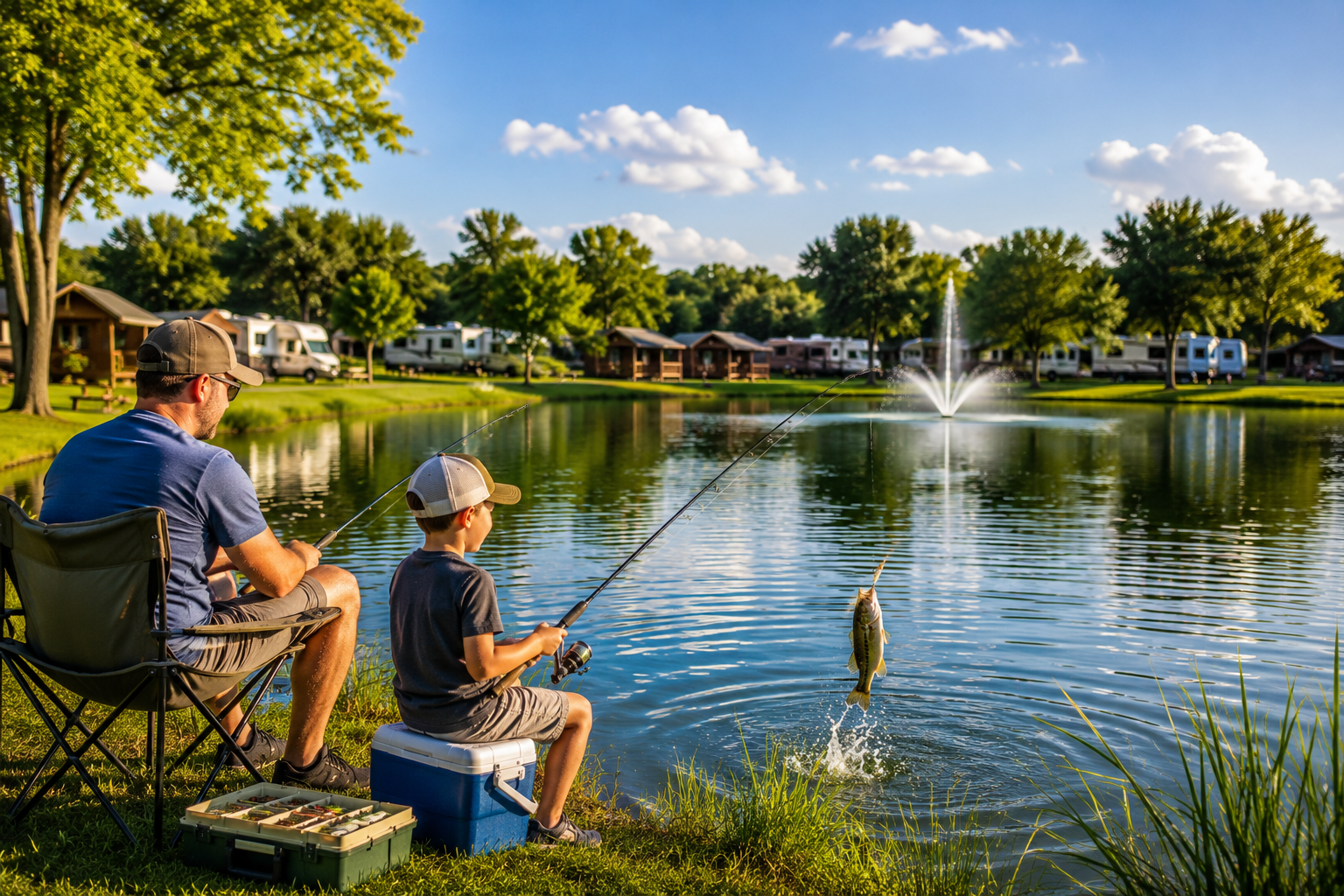
There’s a specific kind of satisfaction in catching a largemouth bass at 7 a.m. before the Kansas heat has fully committed to its July agenda. The pond is still, the frogs have gone quiet, and whatever’s been working in the weeds along the bank is now on your line. Spring Lake RV Resort is set up for exactly this kind of morning — the question is just knowing what’s where and what they’re eating right now.
What July Does to Pond Fish in Kansas
Pond fish in Kansas in July are making two primary adjustments: moving deeper during the midday heat, and compressing their active feeding into the low-light hours at either end of the day. Understanding this is the foundation of productive summer pond fishing, and it’s why the angler at the water at 6 a.m. catches fish while the one who shows up at 11 a.m. is working much harder for the same results.
When pond surface temperatures reach the upper 70s and low 80s°F, fish that were relating to shallow cover in spring move toward the deeper, cooler portions of the water column. On a pond without significant depth variation, they compress into whatever shade and thermal refuge exists — submerged structure, undercut banks, the shadow of an overhanging tree. The dissolved oxygen concentration also drops as water warms, which reduces fish metabolism and feeding frequency during the hottest hours.
The first hour after sunrise and the two hours before dark are when the water surface has cooled enough, and the light level is low enough, that fish move back into shallower water to feed aggressively. That feeding window is shorter in July than in spring, but it’s more intense when it happens — which is why the July dawn bite at Spring Lake can produce more fish in 45 minutes than a full afternoon session.
“July pond fishing is all about the two windows. The angler who fishes the first hour of light and the last hour of light is fishing when the fish are actually feeding. Everybody in between is working for table scraps.”
Largemouth Bass: The Primary Target
Largemouth bass are the primary sport fish in central Kansas warm-water ponds and the species most anglers are targeting at Spring Lake in July. The post-spawn period that follows the May and June bass nesting season leaves fish that have moved back to their summer holding positions — typically near structure, shade, or depth transitions — and are feeding actively to recover condition lost during the spawn.
What Bass Are Doing in July
In July heat, largemouth bass at Spring Lake are likely holding near the pond’s deepest areas during midday and moving to feeding positions in the early morning and evening. Shallow grass lines, overhanging bank vegetation, dock shade (if present), and any submerged object that provides a shade edge are the feeding positions to target during the low-light hours. By 9 or 10 a.m., fish that were active along the shallow bank have typically moved to deeper, cooler water and become significantly harder to trigger.
What’s Working on Bass in July
Morning: topwater lures fished along grass edges and near shaded bank structure are the most exciting early-morning option — a surface strike from a largemouth at first light in a still pond is the experience that makes getting up at 5:30 a.m. feel like a reasonable life choice. Buzzbaits worked slowly along the bank vegetation, poppers walked across open water near weed edges, and prop baits in calmer spots all produce early morning surface strikes when water temperature is cool enough for surface activity.
When the topwater bite winds down by 8 or 9 a.m., soft plastic worms — particularly the Texas-rigged plastic worm in natural colors (green pumpkin, watermelon seed) — fished slowly along the bottom near structure or dropped vertically in the deepest accessible sections of the pond produce summer bass consistently. The presentation is patient and slow: let the worm sink, drag it a foot, let it settle, repeat. July bass in warm water don’t chase fast presentations; they evaluate what’s in front of them.
Evening: the same topwater approach that works in the early morning becomes productive again after 7 p.m., when surface water cools and fish move back shallow. Spinnerbaits and crankbaits worked along grass edges in the late evening often produce fish that weren’t interested in anything during the afternoon.
Channel Catfish: The Summer Specialist
Channel catfish are the species that July conditions genuinely favor over largemouth bass, at least in terms of consistent daytime productivity. Catfish tolerate higher water temperatures than bass and feed actively throughout the day in conditions that push bass into lethargic midday behavior. A catfish rod set with the right bait and left on a bank holder while you wait under a shade tree is July pond fishing in its most honest, most Kansas form.
Catfish Bait and Timing
Channel catfish in warm-water Kansas ponds in July respond best to stink baits and natural baits — prepared catfish bait, chicken liver, cut bream or shad if available, and nightcrawlers. The warm water amplifies scent dispersal, which is actually an advantage for catfish anglers: the bait’s scent column reaches fish at greater distances than it would in cooler water. Bottom rigging with a slip sinker is the standard setup — weight heavy enough to hold position in any current, leader 12 to 18 inches, hook sized to the bait being used.
Unlike bass, catfish in summer ponds are catchable throughout the day — the evening hours (7 p.m. onward) are peak activity, but a catfish rod in the right spot will produce bites from mid-morning through the afternoon. This makes catfish the summer fishing option for anglers who aren’t getting up for the 6 a.m. bass bite and want a productive midday pond session without changing their schedule.
Bluegill and Sunfish: The All-Day Option
Bluegill and other sunfish species are the most accessible year-round pond target and the fish that families with kids specifically rely on for a guaranteed bite session. In July, bluegill hold in the warmer water more comfortably than bass and feed throughout the day, though peak activity is still the morning and evening hours.
Light tackle — a bobber, small hook, and a piece of nightcrawler or a small soft plastic grub — is all that’s needed. Bluegill along the bank vegetation and near any visible shade structure will hit a bobber and worm presentation reliably, which makes this setup the right one for a kid who’s learning to fish or for an adult who wants a relaxed session that produces actual fish rather than endless casting practice.
For families staying at Spring Lake with children who want the fishing experience, the bluegill and sunfish bite in the morning and early evening is the most kid-friendly option — the bites are frequent, the fish are aggressive, and the feedback loop that makes fishing enjoyable (cast, wait, catch something) is much tighter than bass fishing on the same pond in the same conditions.
What to Bring: The July Kansas Fishing Kit
July pond fishing in Kansas has specific gear requirements beyond the standard tackle box. Sunscreen — applied before you get to the water and reapplied after any sweating — is not optional for a morning fishing session that runs into 9 or 10 a.m. with direct sun. A wide-brim hat and polarized sunglasses (which also allow you to see fish position in the water much more clearly, improving presentation accuracy). Insulated water bottles — warm water is hard to drink in quantity, and dehydration in Kansas summer heat sneaks up on anglers who are focused on the rod rather than how much they’ve drunk. Bug spray: the morning fishing window near water in July is active mosquito time, particularly in the low-light early morning period that’s also peak fishing. And ice in the cooler for any fish you intend to keep — warm-water fish in 90°F ambient conditions deteriorate fast, and keeping them on a stringer in warm pond water is not preservation.
Largemouth bass: topwater along bank edges and grass lines, 6–8:30 a.m. and 7–9 p.m. Texas-rigged worm slow on bottom during midday in deepest available water.
Channel catfish: stink bait, chicken liver, or cut bait. Bottom rig with slip sinker. Catchable all day — peak evening 7 p.m. onward. Best summer daytime option.
Bluegill/sunfish: bobber, small hook, nightcrawler or small grub. Along bank vegetation. All day, peak morning and evening. Best option for kids and casual anglers.
Best times: 6–8:30 a.m. and 7–9:30 p.m. Midday is slow for bass; catfish remain productive.
License: Kansas fishing license required. Annual license at kdwp.state.ks.us or from local licensed retailers.
For guests staying at the park who want the full picture of what’s on-site, the Spring Lake park amenities page covers the fishing access and other on-site features. Guests approaching from the Wellington, Kansas corridor to the south can check the RV park near Wellington, KS page for that approach direction. For short-term stays planned around a fishing trip, the short-term stay reservation page has current availability. For anglers considering a longer stay — a week or more during peak fishing season — the extended stay rates may apply. And for everything about the park, Wichita RV Park is the starting point.
Frequently Asked Questions
What fish are in Spring Lake at the RV resort in Halstead, KS?
Spring Lake RV Resort’s pond water supports the warm-water fish species typical of central Kansas lakes and ponds: largemouth bass, channel catfish, and bluegill/sunfish are the primary species available to anglers. These are the same species found throughout the Cheney Reservoir watershed area and the Harvey County water system. The specific stocking history and current population of each species varies by pond and year; for the most accurate current picture of what’s available and producing bites, asking on arrival at the park office or comparing notes with other anglers who’ve fished the water that week is the most reliable approach.
Do I need a fishing license to fish at Spring Lake RV Resort?
Yes. Kansas state law requires a valid Kansas fishing license for anyone 16 years of age or older fishing in any waters of the state, including private ponds that are accessible to the public such as an RV resort’s pond. Kansas annual fishing licenses are available online through the Kansas Department of Wildlife and Parks (kdwp.state.ks.us), through the KDWP app, or from licensed retail vendors in Halstead and the surrounding area. Day licenses are also available for visitors who want a single-day option rather than an annual license. Fishing without a valid license in Kansas is subject to fines. Children under 16 do not require a fishing license.
What is the best bait for bass fishing in Kansas ponds in July?
In July, the most consistently productive bass presentations for Kansas warm-water ponds are topwater lures (buzzbaits, poppers, prop baits) fished in the first 60 to 90 minutes of morning light when surface temperatures are cool enough for topwater strikes, and Texas-rigged soft plastic worms fished slowly on the bottom during the midday and afternoon hours when bass have moved to cooler, deeper water. Natural colors — green pumpkin, watermelon seed, brown — outperform bright colors in clear-to-stained Kansas pond water. Spinnerbaits and crankbaits worked along grass edges in the evening produce bass consistently when fish move back shallow after 7 p.m. The “match the hatch” principle is less rigidly applicable in warm-water ponds than in trout streams, but presentations that imitate the size and movement of what bass are feeding on — small shad, bluegill, frogs along the bank — will produce in July conditions.
Why is early morning fishing better in July than afternoon?
July pond surface temperatures in Kansas typically reach 80-84°F by afternoon, at which point largemouth bass — whose optimal feeding temperature range is approximately 65-80°F — are experiencing thermal stress and reduced feeding motivation. Bass move to the deepest, coolest, most shaded water available and reduce their activity. Dissolved oxygen levels also drop in warm water, which reduces metabolism and feeding frequency. In the early morning, before the sun has had time to warm the surface layer, pond temperatures are several degrees lower than midday peaks, fish are metabolically more active, and the low-light conditions reduce visibility-based wariness. This combination of cooler water, more active metabolism, and reduced light penetration produces the early morning feeding window that experienced summer anglers specifically plan their schedule around.
Can I catch catfish during the day in summer at Spring Lake?
Yes. Channel catfish are significantly more heat-tolerant than largemouth bass and feed actively during the midday hours when bass activity is at its lowest. A bottom rig with stink bait, chicken liver, or cut bait set in a productive spot on the pond bottom produces catfish throughout the day in July — with peak activity in the evening from 7 p.m. onward, when catfish move more actively. This makes catfish the go-to daytime summer option for anglers who want to fish during the warm midday hours without the dramatically reduced success rate that characterizes bass fishing during the same period. Setting two rods with catfish rigs and waiting in the shade while monitoring the tips is a perfectly productive July midday fishing approach.
Is fishing at Spring Lake included in the campsite fee?
Pond fishing access at Spring Lake RV Resort is an on-site amenity available to resort guests. Whether a separate fishing fee applies or access is included with the campsite reservation is best confirmed directly with the park at the time of booking or on arrival — campground amenity fee structures vary and can change between seasons. Regardless of any resort-level access arrangement, Kansas state fishing licenses are required for all anglers 16 and older regardless of where the water is located. The park’s current amenity details and any associated fees are at the Spring Lake amenities page on the resort website.