
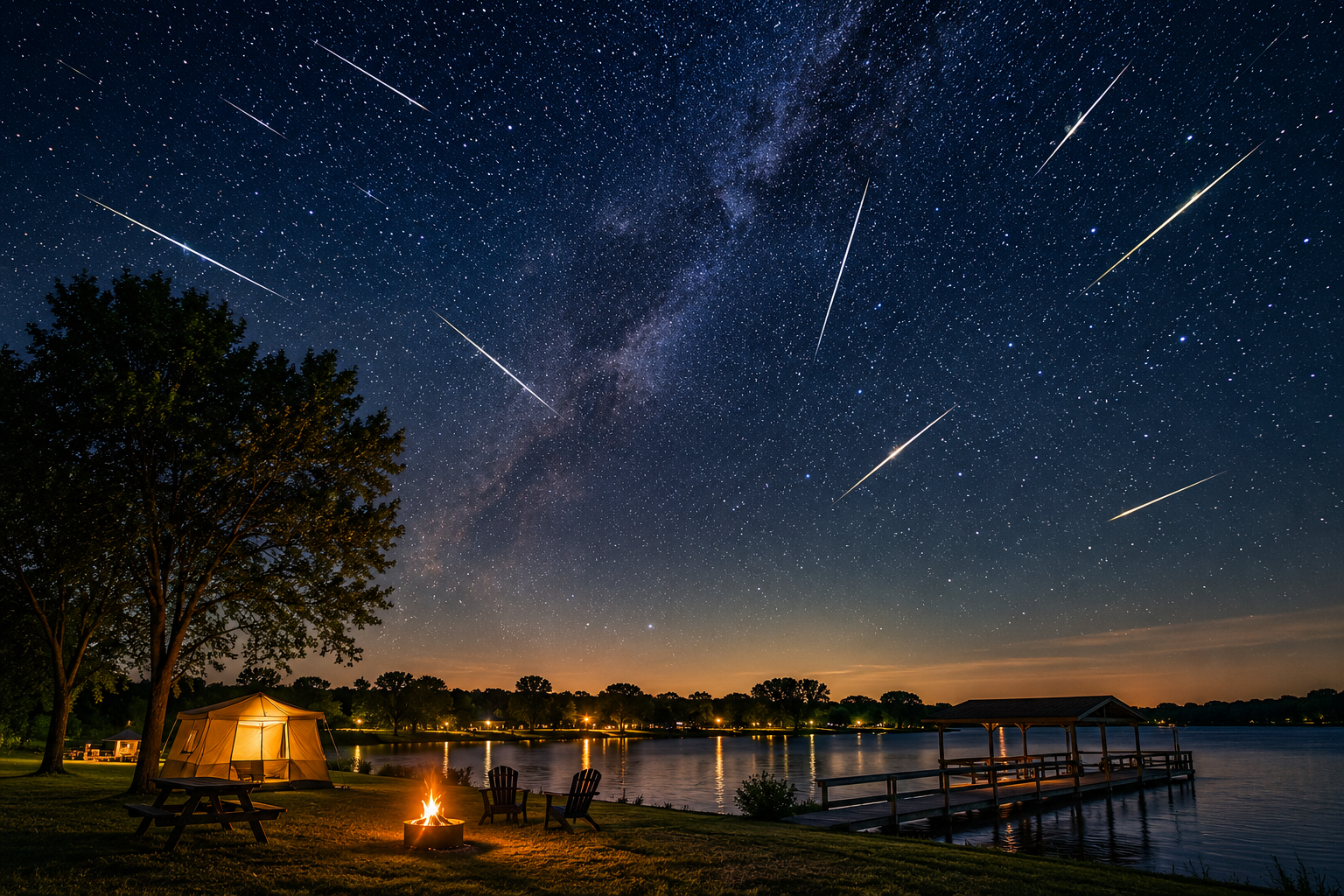
The 2026 Perseids are shaping up to be one of the best viewing years in a long stretch — the peak lands almost exactly on a new moon, meaning essentially zero moonlight competing with the meteors. Pair that rare timing with Spring Lake’s genuine distance from Wichita’s city lights, and Halstead is set up for one of the better meteor shower viewing opportunities Kansas will see in years.
2026 Peak Dates and Why This Year Stands Out
The Perseids are active from mid-July through late August, with the shower peaking overnight on August 12 into the early morning hours of August 13, 2026. What makes 2026 genuinely special is the moon phase: the peak falls almost exactly on a new moon, meaning there will be virtually no moonlight washing out the fainter meteors. A bright moon is normally the biggest obstacle to good meteor viewing, since it lights up the sky and drowns out everything but the brightest streaks — this year removes that obstacle almost entirely.
Adding to the rarity, August 12, 2026 also hosts a total solar eclipse — the first time this century that a Perseid peak and a total solar eclipse have landed on the same date. The path of totality doesn’t cross Kansas, so this won’t be visible locally as a total eclipse, but it’s a genuinely notable piece of 2026 astronomical trivia even for viewers only watching the meteors that night.
“A year like this doesn’t come around often — a Perseid peak lining up almost perfectly with a new moon. Most years you’re working around some amount of moonlight no matter where you set up. This year, especially somewhere as dark as it gets out at Spring Lake, the moon just isn’t a factor at all.”
Why Spring Lake’s Setting Is Already an Advantage
Halstead sits far enough from Wichita’s own light dome that the night sky here is genuinely darker than what most visitors are used to seeing from a city or suburban setting. Spring Lake’s own grounds, away from any significant concentration of outdoor lighting, give guests a real head start on dark-sky viewing without needing to drive out to a dedicated dark-sky destination somewhere else in the state.
This same quiet, dark setting is exactly what makes Spring Lake a genuinely good spot for unwinding after sunset generally, not just during a specific astronomical event. The relaxing lakeside evenings guide covers the broader appeal of a quiet Spring Lake evening, and Perseid peak night is simply that same setting put to particularly spectacular use.
Best Viewing Times for the 2026 Peak
The Perseid radiant — the point in the sky the meteors appear to streak from, located near the constellation Perseus — rises in the late evening and climbs highest just before dawn. This means the best viewing window is after midnight through the hours just before sunrise on both August 12 and August 13, rather than early evening. NASA’s general guidance is to start watching around 11 p.m. local time, when meteor rates begin picking up, with the bulk of activity concentrated between midnight and dawn.
Under ideal dark-sky conditions with the radiant high overhead, NASA estimates viewers can see an average of up to 100 meteors per hour at the peak — one of the higher rates of any annual shower, and genuinely worth staying up for given this year’s moonless conditions.
Finding the Radiant
Look toward the northeast after 10 p.m. and find Cassiopeia, the distinctive “W” or “M”-shaped constellation — Perseus sits just below it. You don’t need to stare directly at the radiant, though; meteors near that exact point actually have shorter visible trails, so looking generally upward and across a broad swath of the sky gives a better overall view than fixating on one spot.
Setting Up for a Good Night of Viewing
A spot along the lake with an open view of the sky, away from any nearby building or tree line blocking a wide swath overhead, gives you the best chance of catching meteors across the full sky rather than just one section of it. Bringing a reclining chair or blanket for comfortable extended viewing, since the best activity happens well after midnight and genuinely rewards patience over a quick five-minute look outside.
Practical Viewing Tips
Give your eyes real time to adjust to the dark — meaningful dark adaptation takes about 20 to 30 minutes, and checking a bright phone screen during that window resets the process. If you need light at all, use a red-light flashlight or your phone’s night mode setting rather than full brightness. Bring a light jacket even in August, since sitting still for hours after midnight near the water can get cooler than the daytime heat suggests, and insect repellent is worth having given Kansas’s summer bug activity near a lake setting.
No telescope or binoculars are needed for the Perseids, and NASA specifically emphasizes this point — meteors move too fast and cover too much sky for optical aids to help. Your unaided eyes, given time to properly adjust, are genuinely the right tool for this particular sky event.
Weather Is the Deciding Factor This Year
With the moon effectively out of the equation in 2026, weather becomes the single biggest variable determining whether peak night actually delivers. Checking the forecast in the days leading up to August 12 and 13, and having a backup night in mind, gives you flexibility if clouds move in on the exact peak date. Meteor activity remains strong on the nights immediately before and after the peak, specifically August 11 and August 14, given the extended dark-sky conditions surrounding the new moon.
Peak: overnight August 12 into early morning August 13, 2026. Moon: new moon (0% illumination) — ideal dark-sky conditions.
Why Halstead specifically: genuine distance from Wichita’s light dome gives Spring Lake noticeably darker skies than a city or suburban setting.
Best viewing window: after midnight through dawn, both nights. Start watching around 11 p.m.; rates build through the night.
Expected rate: up to ~100 meteors/hour under ideal dark conditions (NASA estimate).
Radiant location: near Perseus, below Cassiopeia (the “W”/”M” shape), northeast sky after 10 p.m. — look broadly across the sky, not just at the radiant.
Setup tips: an open lakeside spot away from trees/buildings, a reclining chair or blanket, light jacket and bug spray.
No equipment needed: unaided eyes work best. Allow 20-30 min for eye adaptation.
2026 bonus: peak coincides with a total solar eclipse (not visible as total from Kansas) — first time this century a Perseid peak and total eclipse have landed on the same date.
Weather note: check forecasts and have a backup night (Aug 11 or 14) in mind, since clear skies are the main remaining variable this year.
For guests planning to be at Spring Lake for peak night, a quiet evening by the water is exactly the kind of setting worth building an August stay around, whether or not the sky cooperates on the exact peak date.
Frequently Asked Questions
When is the Perseid meteor shower peak in 2026?
The 2026 Perseid meteor shower peaks overnight on August 12 into the early morning hours of August 13. The best viewing window is after midnight through dawn on both nights, since the radiant rises in late evening and climbs highest just before sunrise. The shower remains active from mid-July through late August, with meteor rates staying strong on the nights immediately surrounding the peak as well, particularly August 11 and August 14.
Will the moon interfere with the 2026 Perseids?
No, and this is what makes 2026 a particularly strong year for viewing. The Perseid peak coincides almost exactly with a new moon (0% illumination), meaning there will be virtually no moonlight competing with the meteors. A bright moon is normally the biggest obstacle to good meteor viewing since it washes out fainter meteors, so this year’s new moon timing removes that obstacle almost entirely, leaving weather as the main variable affecting visibility.
Is Spring Lake near Halstead a good place to watch the Perseids?
Yes. Halstead sits far enough from Wichita’s own light dome that the night sky is genuinely darker than what most visitors are used to seeing from a city or suburban setting. You don’t need a certified dark-sky destination to enjoy the Perseids — a reasonably dark sky with an unobstructed overhead view is sufficient, and Spring Lake’s setting away from significant outdoor lighting concentration provides exactly that without requiring a drive to a separate location.
Do I need a telescope to see the Perseid meteor shower?
No. NASA specifically notes that no telescope or binoculars are needed to enjoy the Perseids — the meteors move too quickly and cover too much sky for optical aids to help. Unaided eyes, given 20 to 30 minutes to adjust to the darkness, are the right tool for meteor shower viewing. A wide, unobstructed view of the sky matters far more than any equipment, so finding an open spot along the lake is more valuable than bringing a telescope.
What time should I start watching for Perseid meteors?
NASA’s general guidance is to start watching around 11 p.m. local time, when meteor rates begin picking up, with the best viewing occurring between midnight and dawn. Early evening viewing isn’t recommended, since the Perseid radiant hasn’t risen high enough in the sky yet at that time to produce good rates. The later into the night and closer to dawn you watch, the higher the meteor rate tends to be, as the radiant climbs higher overhead.
What if it’s cloudy near Halstead during peak night?
Checking the weather forecast in the days leading up to August 12 and 13 is worth doing, since Kansas summer weather can shift within a short window. If peak night is cloudy, the nights immediately before and after — specifically August 11 and August 14, 2026 — still offer strong meteor activity under the same continuing new-moon, dark-sky conditions, giving a practical backup option if weather interferes with the exact peak date.