
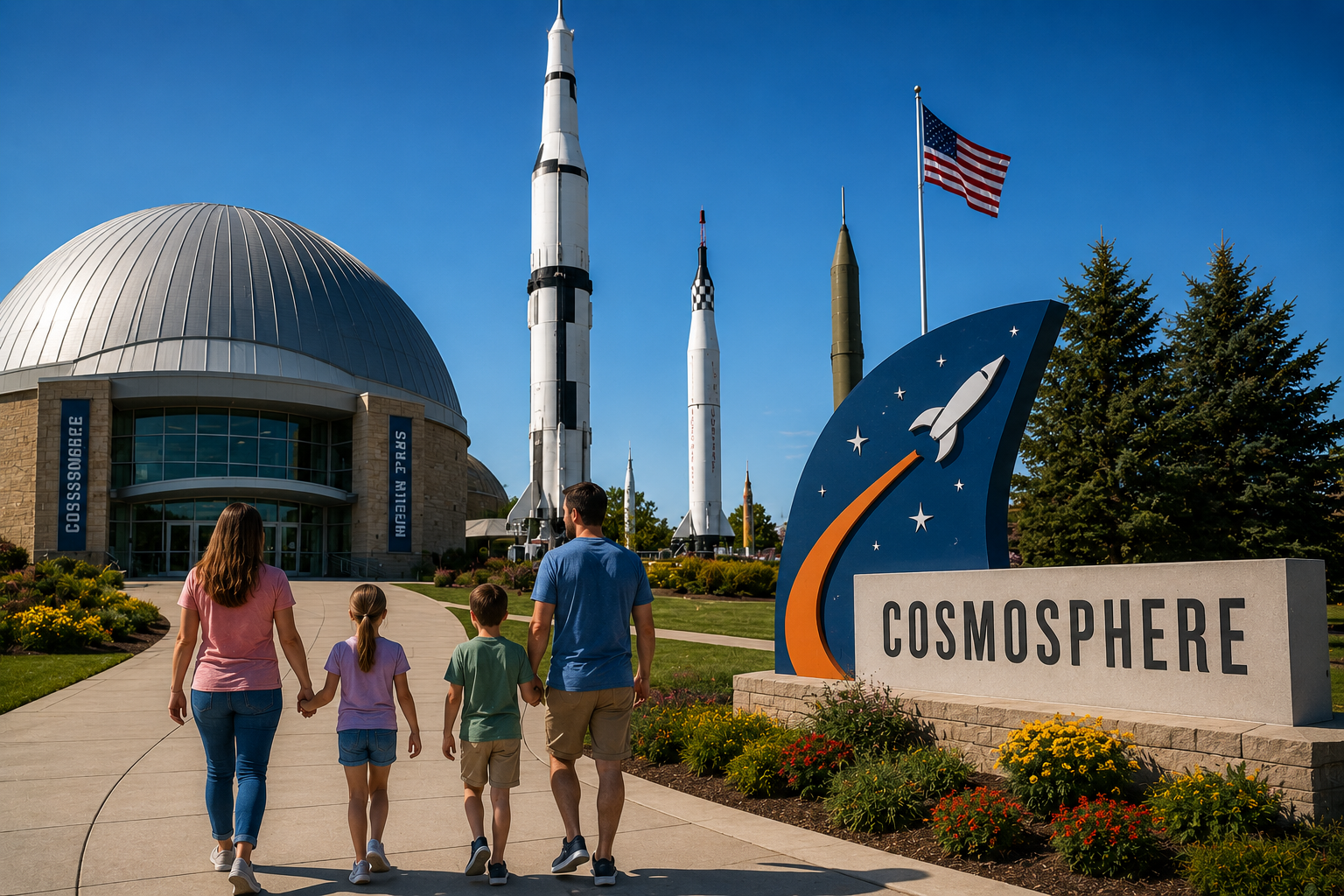
The Kansas Cosmosphere surprises almost everyone who visits it. People drive to Hutchinson expecting a modest regional science center and find one of the most significant collections of space history artifacts in the world. That gap between expectation and reality is part of what makes it worth the trip.
What the Kansas Cosmosphere Actually Is
The Cosmosphere is a Smithsonian Institution affiliate located in Hutchinson, Kansas — which tells you immediately that it’s operating in a different category than most state or regional museums. It houses the largest collection of US and Russian space artifacts outside of the Smithsonian’s own National Air and Space Museum in Washington, DC. That’s not marketing language. It’s a factual statement about the collection that consistently catches visitors off guard.
The collection includes an authentic Liberty Bell 7 capsule — Gus Grissom’s Mercury spacecraft, recovered from the bottom of the Atlantic Ocean in 1999 after being lost there for 38 years. It includes the Apollo 13 command module Odyssey, one of the most symbolically significant spacecraft in NASA history given the mission’s near-catastrophic failure and survival. It holds a German V-2 rocket — one of a very small number of authentic World War II-era V-2 rockets in existence anywhere — and the related hardware that connects the V-2’s development directly to the American and Soviet space programs that followed it.
None of this is replica. These are the actual objects. That distinction is what makes the Cosmosphere a genuinely remarkable place rather than just a well-designed educational facility.
“Standing next to the Apollo 13 command module and knowing that three people came home in that capsule from the edge of not coming home at all — it hits differently than a photograph.”
The Collection in More Detail: What You’re Looking At
The Hutchinson space museum is organized across several halls and floors that move roughly chronologically through the history of the space race and space exploration. Understanding what’s there before you arrive helps you prioritize and makes sure you don’t speed through something genuinely significant because you didn’t know what it was.
Hall of Space Museum: The Artifact Core
This is the main collection hall. The centerpieces are the spacecraft themselves: the Liberty Bell 7 Mercury capsule, the Apollo 13 command module, and the SR-71 Blackbird reconnaissance aircraft suspended above the main floor — one of only a handful of SR-71s on public display. The SR-71 is striking in person in a way that photographs don’t communicate — it’s enormous, entirely black, and looks like something from a decade further in the future than the 1960s when it was actually built. The ceiling height in the main hall is part of the design intent, giving the aircraft room to be at the scale it actually occupies.
The Russian Collection
One of the Cosmosphere’s specific distinctions is its Russian space program collection — unusual for a US space museum given the Cold War competitive context that produced most of these institutions. The collection includes Soviet spacesuits, Sputnik replicas, and hardware from the Soviet side of the space race that contextualizes the American program’s development in ways that a purely US-focused collection doesn’t. Understanding that Yuri Gagarin flew in 1961 and how that affected NASA’s planning is different when you’re standing next to actual Soviet hardware rather than reading about it.
The Carey IMAX Dome Theater
The Cosmosphere’s IMAX dome theater operates on its own programming schedule independent of the museum collection. The specific film showing changes periodically — checking the Cosmosphere’s website (cosmo.org) before the visit confirms current showtimes and programming. The dome format is specifically appropriate for the immersive space and science content that IMAX produces well, and it’s worth planning the visit around a showing if the schedule allows it. Combined museum admission and IMAX tickets are available; buying them together at the front desk or in advance online is typically more efficient than separate purchases.
Dr. Goddard’s Lab
The hands-on science and education component of the Cosmosphere is Dr. Goddard’s Lab — interactive demonstrations and experiments that engage younger visitors (and plenty of adults) with the physics behind rockets and space exploration. If the visit includes kids in the 8 to 14 age range, building in time here before or after the main museum is worth the extra 45 to 60 minutes it takes.
Planning the Day: Logistics from Spring Lake
The Cosmosphere day trip logistics from Spring Lake RV Resort in Halstead are straightforward. US-50 west from Halstead takes you directly to Hutchinson in approximately 40 minutes. The Cosmosphere is located at 1100 North Plum Street in Hutchinson, about a mile north of the US-50/US-61 intersection — easy to find, with on-site parking.
How Much Time to Budget
The collection is larger than most visitors expect. Budget a minimum of 3 hours for a focused visit through the main collection. Four to five hours allows more time in the individual exhibits and an IMAX showing. If the group includes kids who want multiple passes through Dr. Goddard’s Lab or the gift shop (which is genuinely good for space history books, models, and memorabilia), add an hour. Arriving when the museum opens — 9 a.m. on most days — gets the main galleries before the afternoon family crowd.
Admission
Admission pricing varies by age and whether IMAX is included. The Cosmosphere website (cosmo.org) has current pricing, as it adjusts periodically. As of recent visits, adult general admission runs in the $16 to $24 range; IMAX and combination tickets add to this. Smithsonian affiliate membership cards provide admission benefits at some levels — checking if your membership applies before paying is worth a moment at the front desk.
Eating in Hutchinson
The Cosmosphere has an on-site café that handles lunch without requiring a separate trip. For visitors who want to explore downtown Hutchinson dining, the city’s commercial downtown along Sherman Avenue has local restaurants worth checking out — Mexican food, barbecue, and the standard Kansas small-city dining range. Hutchinson’s downtown is about a mile south of the Cosmosphere and walkable if you have time after the museum. The return trip to Halstead in the afternoon is typically smooth — US-50 east has light traffic and the 40-minute drive is pleasant on a Kansas afternoon.
What Else Hutchinson Has to Offer
For visitors who want to add a second activity to the Hutchinson day trip, two options specifically stand out.
Strataca — the Kansas Underground Salt Museum — is located on the south end of Hutchinson and takes visitors 650 feet underground into the working salt mine that underlies the city. Hutchinson sits above one of the world’s largest salt deposits, and the museum gives access to the underground environment through a mine train tour and interactive exhibits. It operates independently of the Cosmosphere and requires a separate admission. Combined museum days that include both the Cosmosphere and Strataca are a full day — budget 7 to 8 hours total and start at one in the morning.
The Hutchinson Zoo, operated by the city and free to the public, is a small but worthwhile stop for families with young children who have capacity for an afternoon activity after the museum. Located in Carey Park along the Arkansas River, it’s about a 10-minute drive from the Cosmosphere.
Distance from Halstead: 35–40 miles northwest on US-50. Drive time: approximately 40–45 minutes.
Address: 1100 North Plum Street, Hutchinson, KS 67501.
Museum hours: typically 9 a.m. – 5 p.m. Confirm at cosmo.org before visiting.
Time needed: 3 hours minimum, 4–5 hours for a full visit including IMAX.
Don’t miss: Liberty Bell 7 capsule, Apollo 13 command module Odyssey, SR-71 Blackbird.
Optional add-on: Strataca underground salt museum, Hutchinson Zoo (free, families with young kids).
For the full picture of day trips and regional activities available from Spring Lake RV Resort, the Halstead area exploration guide covers what’s accessible locally, and the Wichita area activity guide covers the broader regional picture. For guests planning their first stay at the resort, short-term stay options and extended stay rates are both covered on the site. The full park amenities page has the on-site picture. Travelers approaching from the south through Winfield can check the RV park near Winfield, KS page. And for everything about the resort, Wichita RV Park is the starting point.
Frequently Asked Questions
How far is the Kansas Cosmosphere from Halstead, KS?
The Kansas Cosmosphere in Hutchinson is approximately 35 to 40 miles northwest of Halstead on US-50. The drive takes 40 to 45 minutes in normal traffic — US-50 is a straightforward state highway connection between the two communities with no significant traffic complications. From Spring Lake RV Resort in Halstead, the trip to the Cosmosphere and back is easily completed as a day trip, with plenty of time for a full museum visit and an IMAX showing.
What is so special about the Kansas Cosmosphere?
The Cosmosphere is a Smithsonian Institution affiliate that holds the largest collection of US and Russian space artifacts outside of the Smithsonian’s National Air and Space Museum in Washington, DC. Its collection includes authentic objects — not replicas — including the Liberty Bell 7 Mercury capsule (Gus Grissom’s spacecraft, recovered from the Atlantic in 1999), the Apollo 13 command module Odyssey, an authentic German V-2 rocket, and an SR-71 Blackbird reconnaissance aircraft. The combination of these artifacts with the space race historical context that connects them makes the Cosmosphere one of the most significant space history museums in the world — which is the gap between what people expect from a Kansas museum and what they actually find.
How long should I plan for a visit to the Kansas Cosmosphere?
Budget a minimum of 3 hours for a focused pass through the main collection without spending extended time at any single exhibit. Four to five hours allows time for the main collection, Dr. Goddard’s Lab, and an IMAX showing. If the group includes children who want to revisit interactive sections or spend significant time in the gift shop, add an hour beyond the baseline. Arriving at opening (typically 9 a.m.) gives the most time and avoids the afternoon family crowd that builds during peak season. Current hours and IMAX showtimes are confirmed at cosmo.org.
Is the Kansas Cosmosphere good for kids?
Yes, and for a wider age range than most science museums. Dr. Goddard’s Lab provides hands-on interactive content specifically designed for younger visitors (roughly 6 to 14) covering the physics of rocketry and space science. The main collection engages older children, teenagers, and adults through the authentic artifacts — the spacecraft, spacesuits, and rocket hardware produce a visceral engagement that textbooks and videos don’t replicate. The IMAX dome theater handles younger visitors well with its immersive format. Families typically find that the Cosmosphere engages both adults and children genuinely rather than serving one audience at the expense of the other.
What is the Strataca salt mine museum and should I combine it with the Cosmosphere?
Strataca — the Kansas Underground Salt Museum — takes visitors 650 feet underground into the working salt mine beneath Hutchinson via an elevator. Tours include a mine train ride through the tunnels and interactive exhibits about the geology and history of the Permian salt deposit, one of the world’s largest. It operates independently of the Cosmosphere with its own admission. Combining both museums in one day is absolutely possible but produces a genuinely full day — budget 7 to 8 hours total for both, arriving early. Strataca’s website (underkansas.org) has current hours, tour schedules, and admission pricing.
Are there other things to do in Hutchinson, Kansas?
Beyond the Cosmosphere and Strataca, Hutchinson offers the Hutchinson Zoo in Carey Park (free admission, operated by the city, primarily for families with young children), downtown Sherman Avenue dining and local shopping, and the Arkansas River trail system that runs through the city’s park infrastructure. Hutchinson is a city of about 40,000 people with the general commercial range of a south-central Kansas agricultural hub. For visitors whose main goal is the Cosmosphere and Strataca, the rest of the city’s amenities are supplementary — a lunch stop downtown and a zoo visit for families with younger children covers the typical full-day Hutchinson itinerary.