
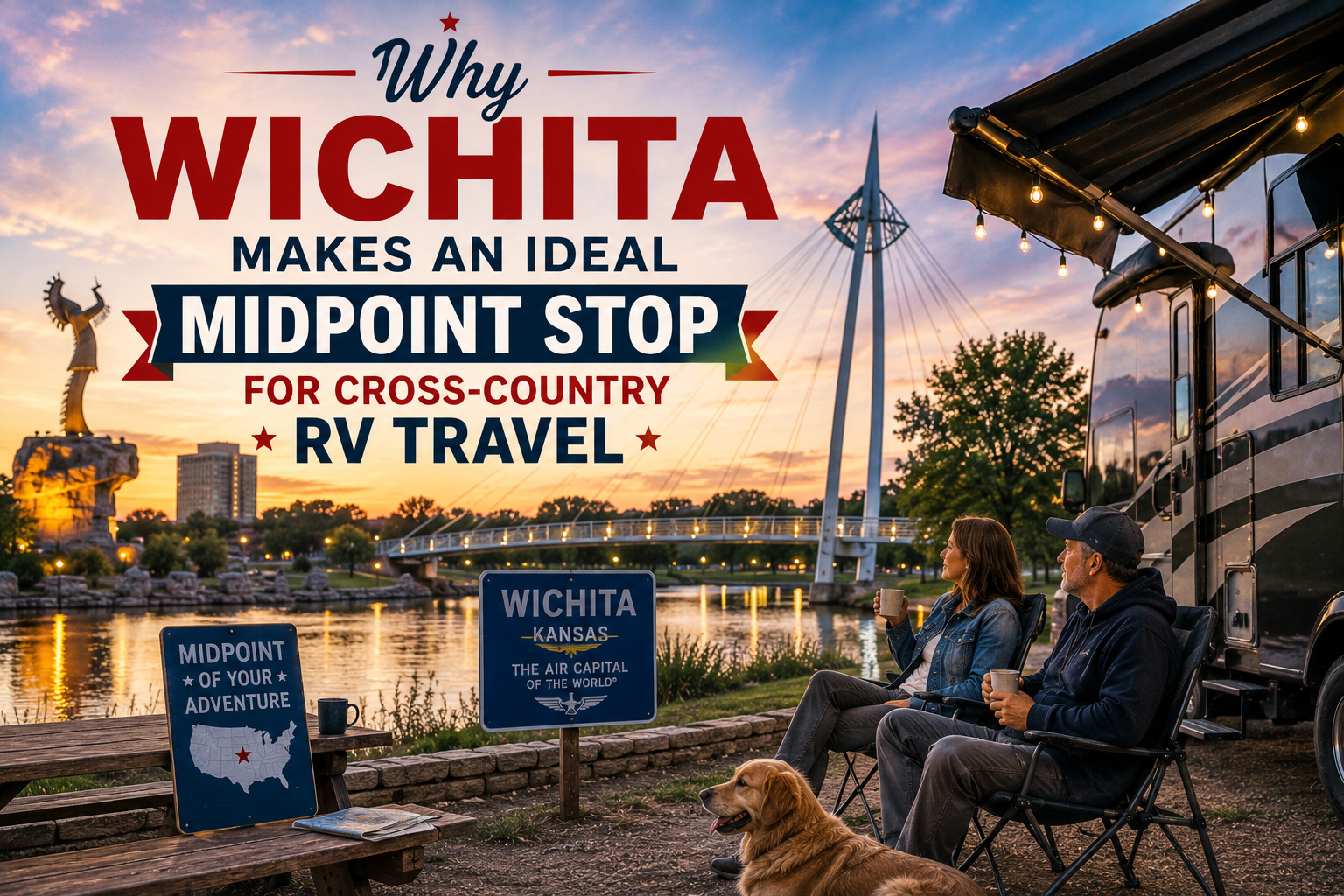
Kansas gets driven through more than it gets stopped in. That’s a mistake — especially if you’re heading across the middle of the country with an RV and a schedule that has a little room in it.
Wichita is that city for cross-country RV travel through the American Midwest. Its position in south-central Kansas makes it a natural midpoint on a range of east-west and north-south routes. Its infrastructure — for RV travelers specifically — is better than most equivalently sized cities in the region. And its character, once you actually get off the highway and drive around, is genuinely interesting in ways that several nights is enough to explore.
This guide makes the case for the Wichita RV stopover — and gives you the practical information to make it work.
The Geography Case: Why Wichita Is Where It Is
Look at a map of the continental United States and find the middle. You’re looking at Kansas. And Wichita sits in the southern third of the state, at the junction of I-135 running north-south and US-54/400 running east-west, with US-81 cutting through and I-35 connecting it to Oklahoma City to the south and the rest of the Kansas City corridor to the north.
For cross-country RV travel in Kansas, this positioning means Wichita falls naturally into several major travel corridors:
East-to-west routes crossing the middle of the country — heading from Missouri or the Ozarks toward Colorado, New Mexico, or beyond — pass within easy reach of Wichita. North-south travelers moving from Minnesota and the upper Midwest toward Texas, Oklahoma, or the Gulf Coast pass directly through it. And the diagonal routes — travelers heading from the Pacific Northwest toward the Southeast, or from Texas toward the Northern Rockies — often find Wichita the most logical overnight stop in a multiday journey through the Great Plains.
The practical upshot: if you’re crossing the Midwest in an RV and you haven’t thought about Wichita specifically, it’s worth reconsidering your route.
“The best cross-country stops aren’t always the ones you planned for. Sometimes they’re the cities you drove past a dozen times before someone convinced you to stop.”
What Makes Wichita Work for RV Travelers Specifically
Geographic positioning is necessary but not sufficient. Lots of cities sit at useful junctions but offer poor RV infrastructure, limited services, or just nothing compelling to do while you’re there. Convenient RV stops in the Midwest need to check several boxes beyond just being on the right road.
Accessible Roads and Parking
Wichita’s road network around the major corridors is well-suited to large vehicles. The city was largely developed in the automotive era, which means wider roads, easier turning radii, and fewer of the tight historic-district navigational challenges that make some otherwise appealing cities difficult in a Class A or with a long tow vehicle. The RV parks in and around the metro area are connected to the main highway system without requiring extended navigation through congested urban streets. For full-time RVers who have been frustrated by urban access issues in other Midwest cities, Wichita is notably more manageable.
Full-Service Campgrounds and Hookup Quality
Short-term stopover RV travel needs reliable, full-hookup sites. Not primitive camping, not partial hookups with marginal water pressure — actual 30 or 50 amp connections, functioning water and sewer, and the kind of site setup that lets you arrive at 4 p.m. and have everything sorted by dinner. The Wichita market has options that meet this standard, and the short-term stay options at Wichita RV Park are designed specifically for travelers in transit who need a quality overnight or two-night experience without the complexity of a long-stay booking.
Fuel, Supplies, and Vehicle Services
Practical cross-country RV travel requires periodic maintenance and supply stops. Wichita has the commercial infrastructure of a mid-sized city — diesel fuel at multiple price-competitive stations, RV-friendly big box retailers for resupply, RV service and parts availability, and the automotive services that become important when something on the rig or tow vehicle needs attention mid-journey. Smaller Kansas towns have charm but not always the service options that a cross-country traveler might need urgently. Wichita has those options reliably.
Road Trip Stop Ideas: What to Actually Do in Wichita
This is the part that most road trip stop ideas in Wichita guides underdeliver on. They list the obvious things — Old Cowtown Museum, the Keeper of the Plains sculpture, maybe a few restaurant recommendations — and leave it at that. Which is fine for an overnight, but undersells what a two-night Wichita stop actually offers.
The Keeper of the Plains and the River Walk
The 44-foot steel sculpture at the confluence of the Arkansas and Little Arkansas rivers is, by any measure, one of the more striking pieces of public art in the Midwest. The surrounding pedestrian bridge and river walk make it a proper destination rather than a drive-by. In the evenings, the fire rings at the base of the sculpture are lit at designated times — worth timing your visit for. This is a free, accessible, genuinely impressive experience that takes about an hour and doesn’t require a reservation.
Old Town Wichita and Local Food
The Old Town district has brick warehouses converted into bars, restaurants, and event spaces — the kind of evening neighborhood that a city like Wichita earns slowly over decades. For cross-country travelers who’ve been eating in their own kitchens or at chain restaurants for a week, a proper sit-down dinner in Old Town is worth the short drive from most campsite locations. The weekend farmers market in the adjacent block is one of the better ones in the state for local produce, baked goods, and regional food products.
Day Trip to Halstead
If you have a second day in Wichita and want to see a different side of south-central Kansas, the small-town historic district in Halstead — about 25 miles northwest — is worth the drive. The Halstead exploration guide gives you the full picture of what’s there, but the short version is: preserved 19th-century commercial architecture, good local cafés, and the kind of small-town Kansas character that road-trippers who’ve only seen the state from the highway don’t know exists.
RV Route Planning: The Wichita Corridor in Context
Good RV route planning treats midpoint stops as an asset rather than a logistical necessity. The difference between a great cross-country trip and an exhausting one is often in whether the stops are places you wanted to be for a day, or just places you slept before the next driving day.
Wichita works as a midpoint because it’s genuinely interesting for a day or two — but it also works logistically. The driving distances in both directions from Wichita are manageable: roughly 3 to 4 hours to Oklahoma City to the south, 3 hours to Kansas City to the northeast, 5 to 6 hours to Denver to the northwest, 2 to 3 hours to the I-70 corridor for westbound travelers, and 4 to 5 hours to Amarillo for those heading toward New Mexico. In any of these directions, Wichita falls at a natural stopping point rather than an awkward one.
For travelers whose cross-country route takes them south of Wichita into the Cowley County area, the RV park near Winfield is worth knowing about — another solid stopover option in the south Kansas corridor for routes coming up from Oklahoma or heading toward it.
Staying Longer: When the Stopover Becomes a Stay
Not every cross-country traveler is in a hurry. Some are making a major move — relocating across the country and taking the trip slowly. Others are retirees who have the time to extend any interesting stop into something more substantial. And some just arrive in Wichita and find, unexpectedly, that they’re not done with it after two nights.
For those situations, Wichita has more to offer than a stopover stop. The broader city — its cultural institutions, food scene, surrounding small towns, and recreational access — supports a longer stay comfortably. The long-term stay options at Wichita RV Park are specifically designed for extended visits, with the kind of setup and pricing structure that makes a week or more genuinely comfortable rather than just tolerated.
For anyone considering an extended stop, the Wichita area exploration guide gives a substantive picture of what the city has to offer across food, culture, history, and outdoor recreation — much more than the overnight-stop highlights list that most travel guides stop at.
The park amenities at Wichita RV Park give you the infrastructure details for planning your stay — hookups, services, site configurations — so you can match your rig’s needs to what’s available before you book. And Wichita RV Park is the starting point for booking whether you’re planning a one-night pass-through or a week-long layover.
The Honest Case for Stopping in Kansas
Kansas gets unfair treatment in the cross-country travel conversation. It’s the punch line in the geography joke, the state that people claim to drive through without seeing anything. That reputation comes from people who drove I-70 through the northern part of the state and looked at the wheat fields and made a conclusion they didn’t have enough information to make.
South-central Kansas — the Wichita area, the Flint Hills, the river corridors, the small towns with limestone architecture and genuine histories — is a different thing. It’s not a spectacle. It’s not competing with the Rocky Mountains or the Pacific Coast for dramatic scenery. But it has a quiet authenticity that road travelers who stop long enough to look around tend to respond to strongly.
Wichita is the access point. The overnight RV destination in Kansas that turns out to be more than one night. The city that surprises people who expected to just pass through and ended up genuinely glad they stopped. That’s the case, made plainly: stop in Wichita. You probably won’t regret it.
Frequently Asked Questions
What major highways pass through or near Wichita for cross-country travelers?
The primary routes serving Wichita for cross-country travelers are I-35 (running north-south, connecting Wichita to Kansas City to the north and Oklahoma City to the south), US-54/400 (east-west across southern Kansas), I-135 (connecting Wichita north toward I-70 and Salina), and US-81 (running north-south through the center of Kansas). These connections make Wichita accessible from virtually every direction without significant detour, and position it naturally as a midpoint stop for a wide range of cross-country routes through the Great Plains.
How far is Wichita from major destinations in each direction?
Driving distances from Wichita: Oklahoma City approximately 160 miles (about 2.5 hours), Kansas City approximately 190 miles (about 3 hours), Denver approximately 360 miles (about 5.5 hours), Amarillo approximately 320 miles (about 4.5 hours), Tulsa approximately 170 miles (about 2.5 hours), and the I-70/Salina junction approximately 90 miles (about 1.5 hours). These distances make Wichita fall at natural daily-drive midpoints in a range of cross-country route configurations, which is the core of its stopover appeal for RV travelers.
What should I do with one day in Wichita during an RV stopover?
A well-structured single day in Wichita includes a morning visit to the Keeper of the Plains and the river walk area (best in morning light), a lunch stop in Old Town Wichita’s restaurant district, an afternoon at the Wichita-Sedgwick County Historical Museum in the 1892 City Hall building (worthwhile context for what you’re seeing around the city), and an evening meal or drinks in the Old Town district. This covers the highlights without rushing and leaves time for the specific stops that interest you most without feeling packed. If you have only an evening, the Keeper of the Plains fire ring lighting and Old Town dinner covers it well.
Is Wichita easy to navigate in a large RV or with a tow vehicle?
More so than most equivalently sized cities. Wichita’s development pattern, road widths, and signage around the major commercial and RV park corridors are manageable for large vehicles. The RV parks in the area connect to the main highway system without requiring extended navigation through tight urban areas. As with any city, it’s worth planning your route from the highway to your campsite in advance rather than relying entirely on GPS, which can sometimes route large vehicles through inappropriate roads. The areas around I-35, I-135, and US-54 are the most consistently large-vehicle-friendly corridors.
What is the best time of year to stop in Wichita on a cross-country trip?
Spring (April through May) and fall (September through October) offer the most comfortable outdoor conditions in Wichita and the most enjoyable experience of the city’s outdoor spaces — the river walk, the parks, the Old Town outdoor seating. Summer is hot and occasionally severe-weather-prone (Wichita is in Tornado Alley), though the city functions well through the summer months. Winter stopsovers are possible and the city’s indoor attractions remain fully accessible, but the outdoor experience is limited. For stopover travelers with route flexibility, spring and fall stops in Wichita are notably better than summer ones.
Are there good fuel and supply options for RVs near Wichita’s campgrounds?
Yes. Wichita’s commercial infrastructure includes multiple diesel fuel stations along the major highway corridors, RV-compatible big box retailers for resupply (propane, supplies, groceries), and RV service and parts availability that’s significantly better than what’s available in smaller Kansas towns. The combination of competitive fuel pricing (Kansas diesel prices are generally favorable compared to coastal states) and strong service availability makes Wichita a practical stop for RV maintenance and resupply beyond just overnight accommodation. Planning a supply run in Wichita before a longer stretch through more remote territory to the west is a common and sensible strategy.